

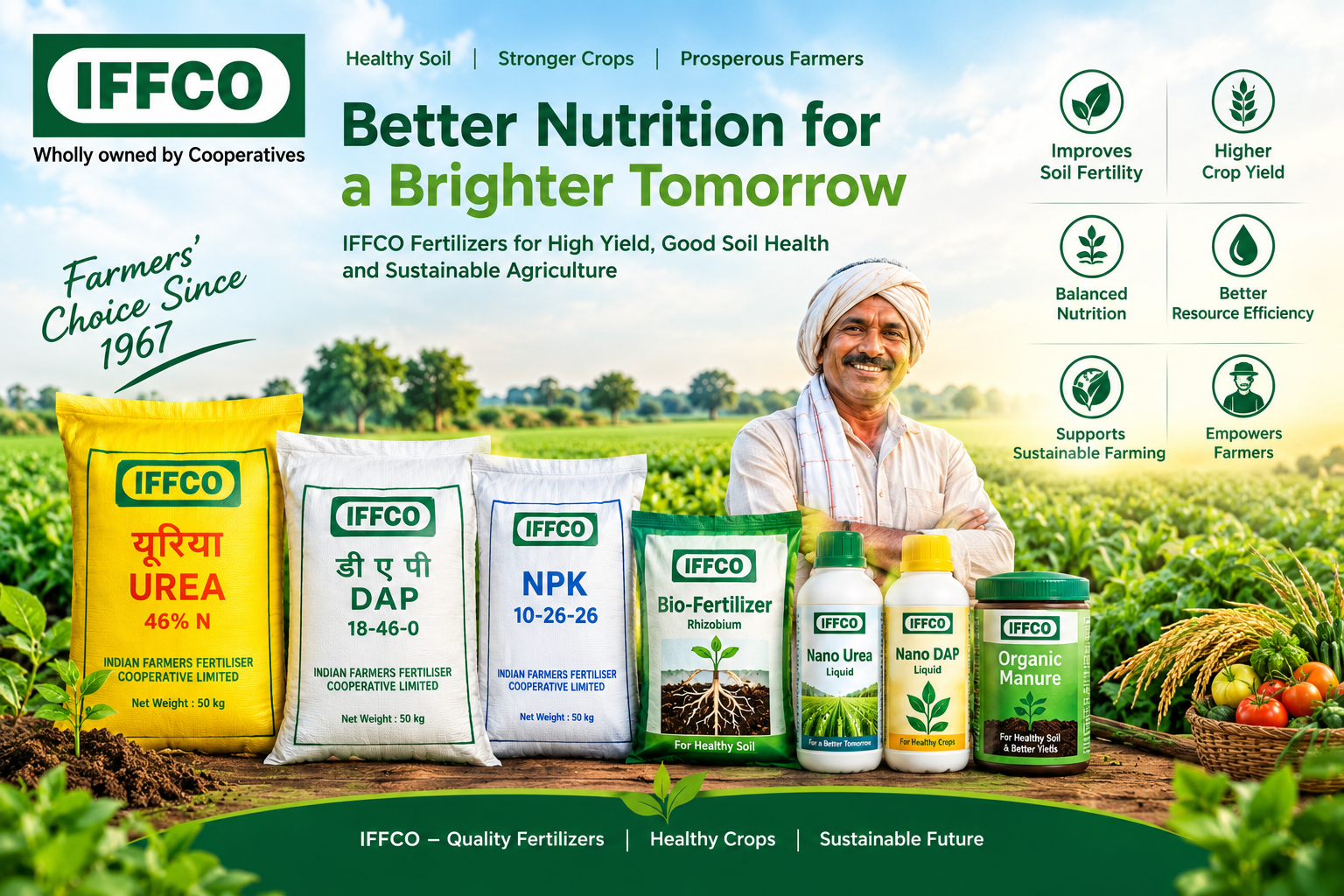
From conventional fertilizers to nano-fertilizers and bio-fertilizers, IFFCO's work reflects the growing importance of scientific farming practices.
Indian agriculture plays a vital role in the country's economy, food security, and rural development. Millions of farmers depend on agriculture for their livelihoods, making sustainable farming practices essential for long-term economic growth and environmental protection. However, challenges such as declining soil fertility, rising input costs, water scarcity, changing weather patterns, and inefficient fertilizer use continue to affect agricultural productivity.
To address these challenges, modern agriculture must balance crop production with responsible resource management. Indian Farmers Fertiliser Cooperative Limited (IFFCO) contributes to this transformation through fertilizer products, agricultural research, farmer education, and innovative crop nutrition technologies.
From conventional fertilizers to nano-fertilizers and bio-fertilizers, IFFCO's work reflects the growing importance of scientific farming practices. Its farmer development programmes also promote soil health, balanced nutrient management, and awareness of modern agricultural techniques.
Sustainable agriculture is not only about producing more food. It is about protecting natural resources, supporting farmers' incomes, improving soil quality, and creating a resilient agricultural system for future generations.
In this article, we explore how IFFCO contributes to sustainable farming, the role of advanced fertilizers and modern technology, and the opportunities and considerations for businesses operating in India's agricultural input sector.
Understanding IFFCO and Its Mission
Indian Farmers Fertiliser Cooperative Limited, commonly known as IFFCO, was established in 1967 as a cooperative organisation serving Indian farmers. Its mission focuses on supplying quality agricultural inputs, improving crop productivity, and supporting farming communities through environmentally responsible practices.
The cooperative model connects agricultural production and distribution with the needs of farmers. By supplying fertilizers and supporting agricultural education, IFFCO contributes to efforts to improve crop nutrition and strengthen rural livelihoods.
Its vision also emphasises balanced fertilizer use, energy-efficient production, environmental health, and stronger cooperative institutions.
IFFCO's contribution extends beyond fertilizer manufacturing. Its farmer development programmes include village adoption initiatives, agricultural extension activities, soil awareness campaigns, and educational efforts designed to promote improved farming practices.
These activities demonstrate why sustainable agriculture requires a combination of suitable products, scientific knowledge, and responsible decisions at the farm level.
1. Why Sustainable Farming Is Important for India
Sustainable farming aims to maintain agricultural productivity while protecting soil, water, biodiversity, and other natural resources. It encourages farmers to make informed decisions about fertilizers, irrigation, crop rotation, pest management, and soil improvement.
Improving Soil Health
Healthy soil provides plants with essential nutrients, supports root growth, retains moisture, and encourages beneficial biological activity. However, continuous cultivation without appropriate nutrient replenishment can reduce soil fertility.
Soil testing helps farmers understand nutrient deficiencies and select suitable fertilizer applications. Combining soil testing with balanced fertilization, crop rotation, organic matter management, and erosion control can support long-term soil health.
Using Water More Efficiently
Water scarcity affects agricultural productivity in many parts of India. Efficient irrigation methods, appropriate watering schedules, and moisture conservation can help farmers use available water more effectively.
Fertilizer application should also be coordinated with crop requirements and irrigation practices to reduce avoidable nutrient losses.
Reducing Unnecessary Input Costs
Applying excessive quantities of fertilizer does not necessarily increase crop yields. It can raise production costs and contribute to nutrient losses.
Farmers can improve input efficiency by following crop-specific recommendations, using soil test results, and applying nutrients at appropriate growth stages.
Preparing for Climate Challenges
Unpredictable rainfall, heat stress, and changing seasonal conditions make agricultural planning increasingly important.
Sustainable farming practices can improve the resilience of farming systems when combined with suitable crop varieties, efficient water management, and informed nutrient planning.

2. IFFCO's Role in Promoting Balanced Fertilizer Use
Balanced nutrient management is a fundamental component of sustainable agriculture. Crops need nitrogen, phosphorus, potassium, and other essential nutrients in quantities that vary according to the crop, soil, and growth stage.
IFFCO provides fertilizer products intended to meet different agricultural nutrient requirements.
For example, urea supplies nitrogen, while diammonium phosphate (DAP) provides nitrogen and phosphorus. Other fertilizer formulations supply combinations of nutrients according to their specified composition.
The important consideration is selecting the right fertilizer and applying it appropriately.
Excessive dependence on a single nutrient can create imbalances, while inadequate nutrient application may limit crop growth. Soil testing and agricultural guidance help farmers identify the most appropriate approach.
IFFCO's stated mission includes promoting optimum fertilizer use and integrated nutrient management. These principles support a broader agricultural strategy in which chemical fertilizers, suitable organic inputs, crop residues, and other soil management practices are considered together.
3. Nano-Fertilizers and Modern Agricultural Innovation
Technology is changing how agricultural inputs are developed and applied. One important area of innovation is nano-fertilizer technology.
IFFCO has developed products such as Nano Urea and Nano DAP, bringing new options into discussions about nutrient delivery and fertilizer-use efficiency.
What Is Nano Urea?
Nano Urea is a liquid fertilizer developed using nanotechnology and intended to supply nitrogen through application methods specified by the product label.
IFFCO's nano-fertilizer range includes Nano Urea Plus, which is designed to provide nitrogen to plants.
Foliar application allows nutrients to be applied to plant leaves, but the effectiveness depends on the product, crop, application timing, weather conditions, and correct usage.
Farmers should follow approved product instructions and agricultural recommendations rather than assuming that liquid nano-fertilizers can automatically replace every conventional fertilizer application.
Understanding Nano DAP
DAP is a widely used fertilizer that supplies nitrogen and phosphorus. Nano DAP provides another formulation for specific nutrient applications, subject to its approved directions.
Its development illustrates how research can explore alternative ways of delivering nutrients to crops.
Farmers should consider the crop's total nutrient requirements, soil conditions, and recommended fertilizer schedule before adopting a new product.
How Technology Can Support Sustainability
Modern fertilizer technology aims to improve nutrient delivery and make agricultural input use more efficient.
Potential benefits, depending on the product and its application, include:
Improved nutrient-use efficiency in suitable conditions.
Additional options for crop nutrition management.
Opportunities to reduce avoidable nutrient losses.
Greater flexibility in selected fertilizer applications.
Support for research into more resource-efficient farming.
Actual results vary with soil conditions, crops, weather, and farming practices. Nano-fertilizers should therefore be viewed as part of an integrated nutrient management strategy rather than a universal solution.
4. The Importance of Organic and Bio-Fertilizers
Organic and bio-fertilizers can contribute to sustainable farming when selected and used appropriately.
Organic materials, such as compost and suitable organic manures, can add organic matter to soil and supply nutrients. Bio-fertilizers contain beneficial microorganisms that can help make certain nutrients more available to plants.
IFFCO's published information on organic and bio-fertilizers describes products such as Rhizobium, Azotobacter, Acetobacter, phosphate-solubilising bacteria, and potassium-mobilising bio-fertilizers.
These products work through different biological processes and are not interchangeable. Their suitability depends on the crop, soil conditions, formulation, storage, and application instructions.
Benefits of Bio-Fertilizers
Appropriately selected bio-fertilizers may help farmers:
Improve the availability of certain plant nutrients.
Support biological processes associated with nutrient cycling.
Complement balanced fertilizer management.
Incorporate biological inputs into sustainable farming systems.
Bio-fertilizers do not necessarily supply all the nutrients required by a crop. Farmers should combine them with suitable nutrient management and follow product-specific guidance.
Integrating Organic and Conventional Inputs
Integrated nutrient management combines suitable organic sources, biological inputs, and mineral fertilizers according to crop requirements.
For example, a farmer may improve soil organic matter through compost while using soil-test-based fertilizer applications to meet the crop's nutrient needs.
The correct combination depends on the farming system and local conditions. Sustainable farming is about achieving an appropriate balance rather than assuming that one category of input is always sufficient.

5. IFFCO's Farmer Development and Soil Awareness Programmes
Agricultural innovation is most useful when farmers understand how to apply it in their own fields.
IFFCO conducts farmer development and extension activities intended to promote scientific farming, balanced nutrient use, and awareness of modern agricultural practices.
Its published farmer development programmes include the Village Adoption Program, Cyber Dhabas and Kisan Sanchar initiatives, and the Save the Soil campaign.
These activities highlight the importance of communicating agricultural knowledge beyond research facilities and manufacturing units.
Village Adoption Programme
Village-based agricultural initiatives can demonstrate improved farming techniques and help farmers understand the importance of balanced fertilization, quality seeds, and scientific farm management.
Demonstrations allow farmers to observe practices under local conditions and discuss their experiences.
Save the Soil Campaign
Soil awareness initiatives encourage farmers to consider soil rejuvenation, crop productivity, and environmentally responsible farming practices.
Healthy soil is essential for long-term agricultural productivity, making soil testing, balanced nutrients, and organic matter management important priorities.
Digital Agricultural Communication
Digital communication can help farmers access crop information, product guidance, and agricultural updates.
However, farmers should use reliable sources and consider local conditions before changing their cultivation practices. Digital information works best when combined with field experience and qualified agricultural advice.
6. Modern Technology Beyond Fertilizers
Sustainable agriculture requires more than new fertilizer formulations. It also benefits from better farm planning, efficient irrigation, reliable weather information, and improved supply chains.
Soil Testing and Precision Nutrient Management
Soil testing provides information about nutrient availability and soil characteristics. Farmers can use these results to make more informed fertilizer decisions.
Precision nutrient management aims to match nutrient applications with crop requirements, reducing unnecessary input use while maintaining productivity.
Efficient Irrigation
Drip irrigation and other suitable water management systems can help deliver water more efficiently in appropriate farming situations.
Irrigation should be coordinated with crop needs and nutrient application to minimise water waste and avoid unnecessary nutrient movement away from plant roots.
Better Farm Recordkeeping
Recording fertilizer applications, irrigation schedules, crop performance, and input expenses helps farmers compare results between seasons.
These records can reveal which practices are cost-effective and where improvements may be needed.
Reliable Agricultural Supply Chains
Farmers need access to genuine agricultural inputs when they are required. Reliable distribution and proper product storage help maintain supply quality and reduce delays during important crop growth stages.
Together, these technologies and management practices can support more informed agricultural decisions.
7. IFFCO Fertilizer Company In India: Supporting Agricultural Development
As a major fertilizer cooperative, IFFCO contributes to India's agricultural input supply chain through its fertilizer products, production facilities, marketing network, and farmer-focused initiatives.
The role of a fertilizer company is not limited to supplying products. Reliable manufacturing, quality control, distribution, and clear product information are also important for agricultural development.
Farmers benefit when suitable products are available through legitimate channels and when they can obtain accurate guidance on their use.
Agricultural retailers and distributors also have an important responsibility. They should supply genuine products, comply with applicable regulations, maintain appropriate storage conditions, and avoid making unsupported claims about fertilizer performance.
A trustworthy agricultural supply chain supports farmers while helping protect the reputation of legitimate manufacturers and cooperative organisations.
8. IFFCO Fertilizer Dealership: What Entrepreneurs Should Know
Agricultural input retailing can interest entrepreneurs who want to serve farming communities. A fertilizer retail business may involve supplying fertilizers and other permitted agricultural products to farmers.
The keyword IFFCO Fertilizer Dealership is often used by people researching this type of business.
However, it is essential to distinguish general fertilizer retailing from an officially authorised dealership arrangement with a particular company.
IFFCO's official website warns that it has not invited dealership or franchise requests and cautions the public against anyone demanding money in its name.
Entrepreneurs should therefore verify any claimed IFFCO dealership opportunity directly through official channels before paying fees, sharing documents, or entering into an agreement.
Important Factors Before Starting a Fertilizer Business
Consider the following factors when researching agricultural retailing:
Local demand for fertilizers and other agricultural inputs.
Applicable retail licences and regulatory requirements.
Suitable storage space and product handling procedures.
Initial investment and working capital.
Seasonal sales and inventory management.
Genuine suppliers and documented purchase arrangements.
Customer service and agricultural product knowledge.
A business plan should be based on verified information rather than guaranteed profit claims.
9. IFFCO Fertilizer Franchise In India and Distributorship Research
Entrepreneurs may also search for IFFCO Fertilizer Franchise In India, IFFCO Fertilizer Dealership In India, or Iffco Fertilizer Distributor In India when exploring opportunities in agricultural distribution.
A dealership, franchise, and distributorship are different commercial arrangements. Their terms, eligibility requirements, and responsibilities can vary.
A distributor may supply agricultural products to retail outlets, while a retailer typically sells products directly to customers. A franchise involves a separate contractual arrangement where one is genuinely offered.
None of these arrangements should be assumed to be available simply because a website advertises them.
IFFCO's official warning makes it particularly important to confirm whether a proposed business opportunity is authorised.
Before making an investment, verify the organisation's identity, written authorisation, commercial terms, applicable licences, and payment arrangements.

10. IFFCO Fertilizer Distributorship and Business Planning
An IFFCO Fertilizer Distributorship search may come from entrepreneurs interested in supplying agricultural inputs across a district or region.
Distribution businesses require careful planning because demand often changes with sowing seasons, weather, crop cycles, and local agricultural conditions.
Entrepreneurs should consider transportation costs, inventory turnover, storage facilities, working capital, and payment cycles before entering the sector.
The broader IFFCO Fertilizer Business Opportunity keyword also reflects interest in agricultural entrepreneurship.
A responsible approach begins with market research and verification of legitimate supply channels. It is important to avoid paying unofficial agents who promise guaranteed authorisation, exceptional returns, or exclusive distribution rights without verifiable documentation.
Building a successful agricultural business requires customer trust, regulatory compliance, genuine products, and realistic financial planning.
11. IFFCO Organic Fertilizer Dealership and Franchise Searches
Interest in organic farming has increased awareness of organic manures, compost, bio-fertilizers, and other soil management inputs.
As a result, entrepreneurs may search for IFFCO Organic Fertilizer Dealership or IFFCO Organic Fertilizer Franchise in India.
These keywords can be used to research the agricultural input market, but they do not establish that a specific dealership or franchise is available.
Anyone interested in selling organic or biological agricultural inputs should verify the relevant products, supplier credentials, and applicable business permissions.
They should also understand that organic farming certification standards may restrict which inputs can be used in certified production systems.
A sustainable business in this category depends on product quality, transparent information, reliable sourcing, and genuine customer demand.
12. IFFCO Fertilizer And Chemical Dealership: Compliance and Responsibility
The keyword IFFCO Fertilizer And Chemical Dealership may reflect interest in selling a wider range of agricultural inputs.
Different products may be subject to different rules. Fertilizers, bio-fertilizers, pesticides, seeds, and other agricultural chemicals can have distinct licensing, storage, labelling, and handling requirements.
Entrepreneurs should identify the regulations that apply to every product category they plan to sell.
They should also provide accurate product information and avoid unsupported claims about yields, environmental benefits, or guaranteed financial returns.
Before entering into a proposed dealership arrangement, verify the supplier's identity and authorisation through reliable official channels.
13. How to Identify the Best IFFCO Fertilizer Dealership Information
People searching for the Best IFFCO Fertilizer Dealership should prioritise authenticity, compliance, and clear documentation.
Do not judge an opportunity only by the design of its website, advertising claims, or promises of high income.
Before making a decision, confirm:
Whether the proposed arrangement is officially authorised.
Whether the organisation has published information about the opportunity.
What licences and registrations are required.
Which products can be supplied and sold.
Whether all fees and commercial terms are documented.
Whether payments are requested through legitimate, verifiable channels.
IFFCO's official website provides contact information that can be used to verify claims. Never assume that an independent website, social media account, or agent is authorised merely because it uses the IFFCO name or logo.
Frequently Asked Questions
1. How does IFFCO contribute to sustainable farming?
IFFCO contributes through fertilizer products, nano-fertilizer research, organic and bio-fertilizer information, and farmer development programmes that promote balanced nutrient management and scientific farming.
2. What is the role of nano-fertilizers in agriculture?
Nano-fertilizers provide additional nutrient delivery options for specific applications. Their effectiveness depends on the product, crop, application method, and growing conditions. They should be used according to approved instructions.
3. Are bio-fertilizers useful for sustainable agriculture?
Suitable bio-fertilizers can support biological nutrient processes and complement other soil fertility practices. Their benefits depend on the microorganism, crop, soil, and application conditions.
4. What is integrated nutrient management?
Integrated nutrient management combines suitable mineral fertilizers, organic inputs, biological products, and other soil management practices according to crop requirements and local conditions.
5. Is IFFCO Fertilizer Dealership currently available?
Do not assume that a dealership is available. IFFCO's official website warns that it has not invited dealership or franchise requests. Verify any claimed opportunity directly through official channels.
6. What should I check before investing in a fertilizer business?
Research local demand, applicable licences, storage requirements, supplier authorisation, working capital, inventory expenses, and the complete commercial terms.
7. Can organic inputs replace all chemical fertilizers?
Not necessarily. Nutrient requirements vary by crop and soil. Suitable organic inputs can complement a balanced nutrient management programme, but farmers should base their decisions on soil tests and qualified agricultural guidance.
Conclusion: Building a Greener Future with IFFCO and Sustainable Farming
Sustainable agriculture is essential for protecting India's soil, conserving natural resources, and supporting the long-term prosperity of farming communities.
IFFCO contributes to this goal through fertilizer products, nano-fertilizer technology, bio-fertilizer information, farmer development programmes, and initiatives promoting balanced nutrient management.
However, sustainable farming requires a comprehensive approach. Farmers need suitable fertilizers, healthy soil, efficient irrigation, reliable agricultural information, and practices adapted to their local conditions.
For entrepreneurs, India's agricultural input sector offers areas worth researching, but every business opportunity must be verified carefully. Whether exploring an IFFCO Fertilizer Dealership, IFFCO Fertilizer Distributorship, or an organic input business, authenticity and regulatory compliance should come before investment.
By combining scientific farming, responsible fertilizer use, agricultural education, and reliable supply chains, India can continue working towards a greener, more productive, and more resilient agricultural future.
IFFCO Blog
